
Wilhelm Maritz
Monday, August 25, 2025 | 4minutes
Johnny Decimal for the files, Zettelkasten for the thoughts
Every organisation system dies the same death: you stop trusting it, so you stop filing into it, so it rots, which proves you were right not to trust it. Mine has survived a few years now, and the reason is that it is actually two systems with a clear division of labour. Johnny Decimal answers “where does this file go?” and Zettelkasten answers “where does this thought go?”. Neither is asked to do the other’s job.
Johnny Decimal in sixty seconds
The Johnny Decimal system gives everything a numeric address. Ten areas (10-19, 20-29, and so on), up to ten categories per area, and numbered items inside those. My actual top level looks like this:
10-19 Personal Administration
20-29 Research and Development
30-39 Work Administration
40-49 Properties and Investments
50-59 Business
Inside an area, the same pattern repeats:
20-29 Research and Development
  21 Resources
    21.01 Courses
    21.02 Learning methods
  23 Paramedic
  24 Programming
    24.01 Python
    24.04 SQL
    24.07 Shells and Terminals
  25 Data Engineering
The address does the navigating for you. Seeing 24.01 tells you it is programming (24) and specifically Python (.01) before you have read a word. When a colleague asks where something lives, the answer is a number, not a set of directions.
The real feature is the constraint. Ten categories per area sounds arbitrary until you realise what it prevents: the endless, improvised nesting that every file tree slides into when adding a folder costs nothing. Johnny Decimal makes you decide what something is before you can put it anywhere, and the one-off cost of that decision is far cheaper than the recurring cost of never being able to find anything.
One system, everywhere. The same numbers span my whole file tree, my cloud storage, and my Obsidian vault, so there is exactly one answer to “where does this go?” regardless of which tool I am holding at the time.
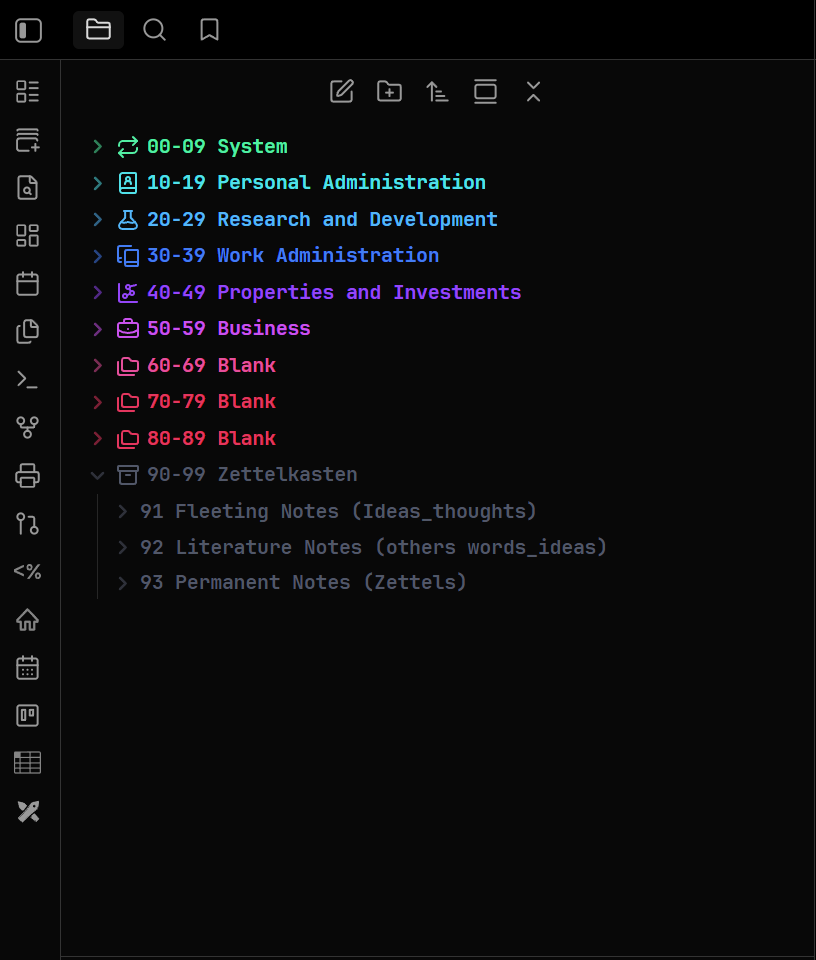
That screenshot gives away another habit worth copying: areas 60 through 89 are named Blank and sit empty. Reserved space means a future part of life gets a number without renumbering anything that already exists.
Zettelkasten for the thoughts
Files are easy; thoughts are the hard part. Notes about ideas do not have a natural folder, because a good idea belongs to five categories at once. So ideas live in a separate area of the vault, organised by maturity instead of topic:
90-99 Zettelkasten
  91 Fleeting Notes    (raw ideas, captured fast)
  92 Literature Notes  (other people's ideas, in my words)
  93 Permanent Notes   (my ideas, fully developed)
Each note gets a timestamp identifier (202508251315 - Johnny Decimal System for Knowledge Management) and a small template: the key idea in one sentence, the content, examples, and why it matters. Links between notes do the categorising that folders cannot.
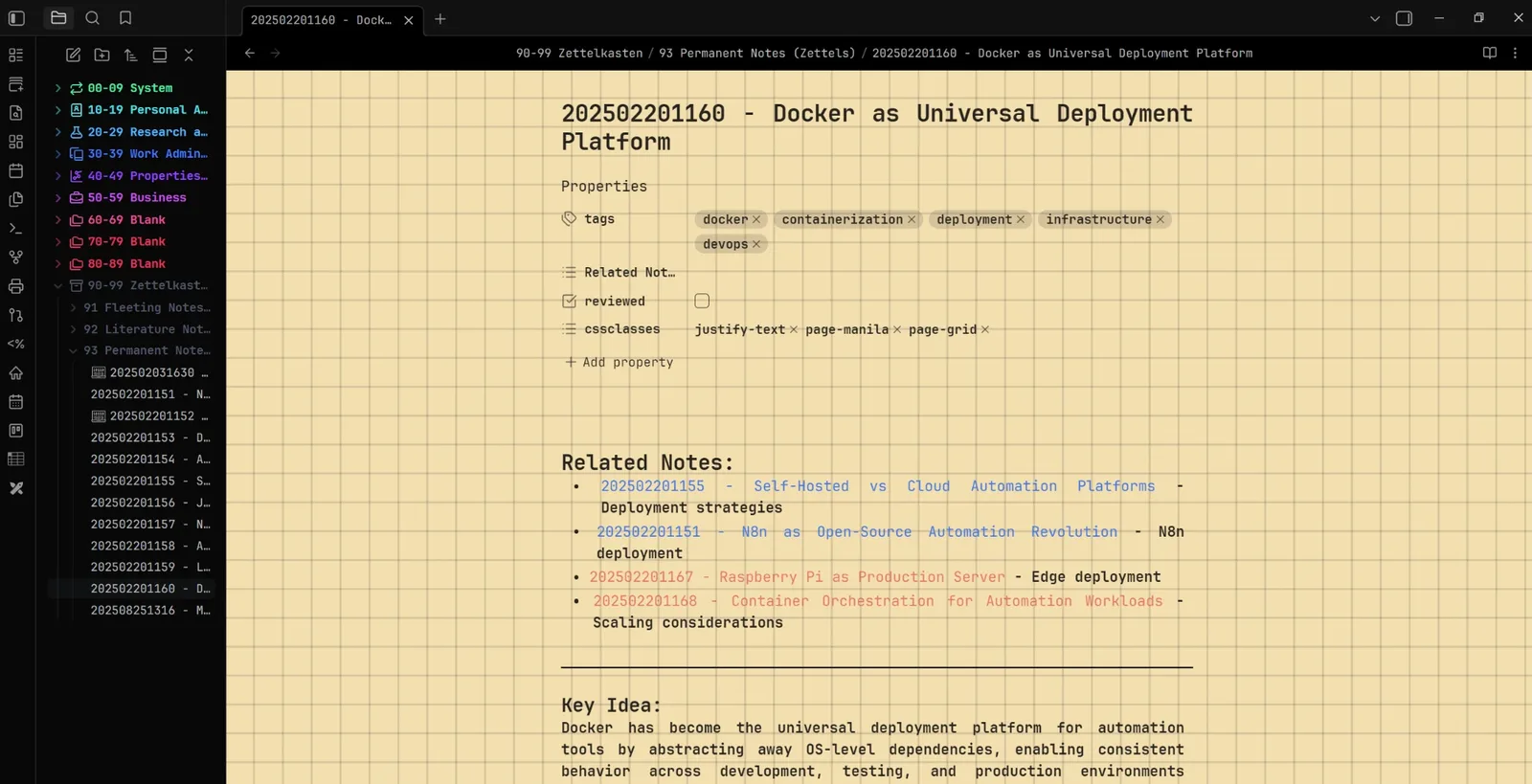
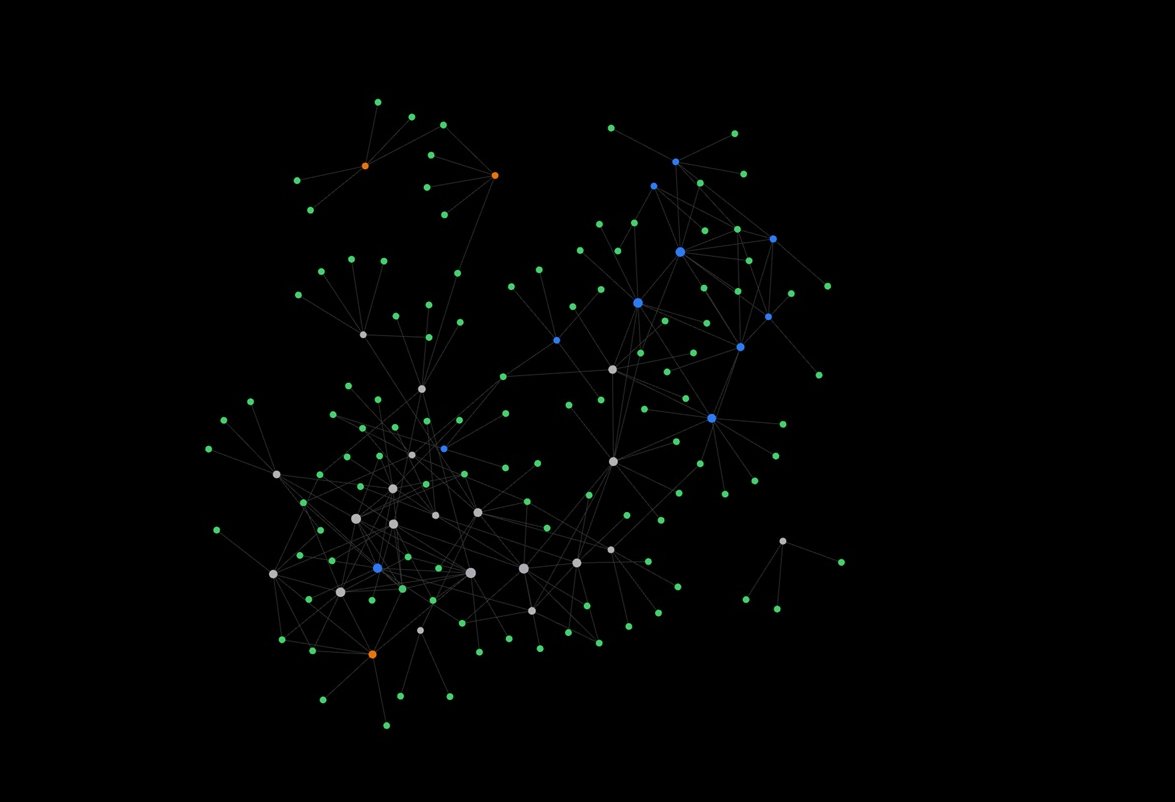
The three-stage pipeline is the point. A fleeting note costs thirty seconds and zero quality control. If it keeps mattering, it earns a literature note (if it came from someone else) or graduates to a permanent note (if it is mine). Most fleeting notes die in 91, and that is the system working: capture is cheap, permanence is earned. Several posts on this site started life as a 91 note that refused to stay quiet.
The honest parts
No system survives contact with a busy life unmodified, so in the spirit of honesty:
- There is a sort-out category. An inbox of things I have not filed yet, inside the system but outside its rules. The difference between this and chaos is that the mess has an address.
- Notes sometimes sit at the vault root for weeks before being filed. My write-up of a RAID failure lived there for months. The system tolerates this because filing something late is a two-minute job when every destination already exists.
- The numbers only stay meaningful if you resist inventing new categories in the moment. The urge to add an eleventh thing is the system asking you whether two of your existing ten are really one.
If you are starting
Do not design the perfect tree up front; you will design it for the person you imagine being. Start with three or four areas you undeniably have, let the rest earn their numbers, and keep ideas out of the file tree entirely. Files want addresses. Thoughts want links. The mistake is giving either one the other’s home.